Overview of Growth Marketing for a Small Business
Key Points of Emphasis:
-
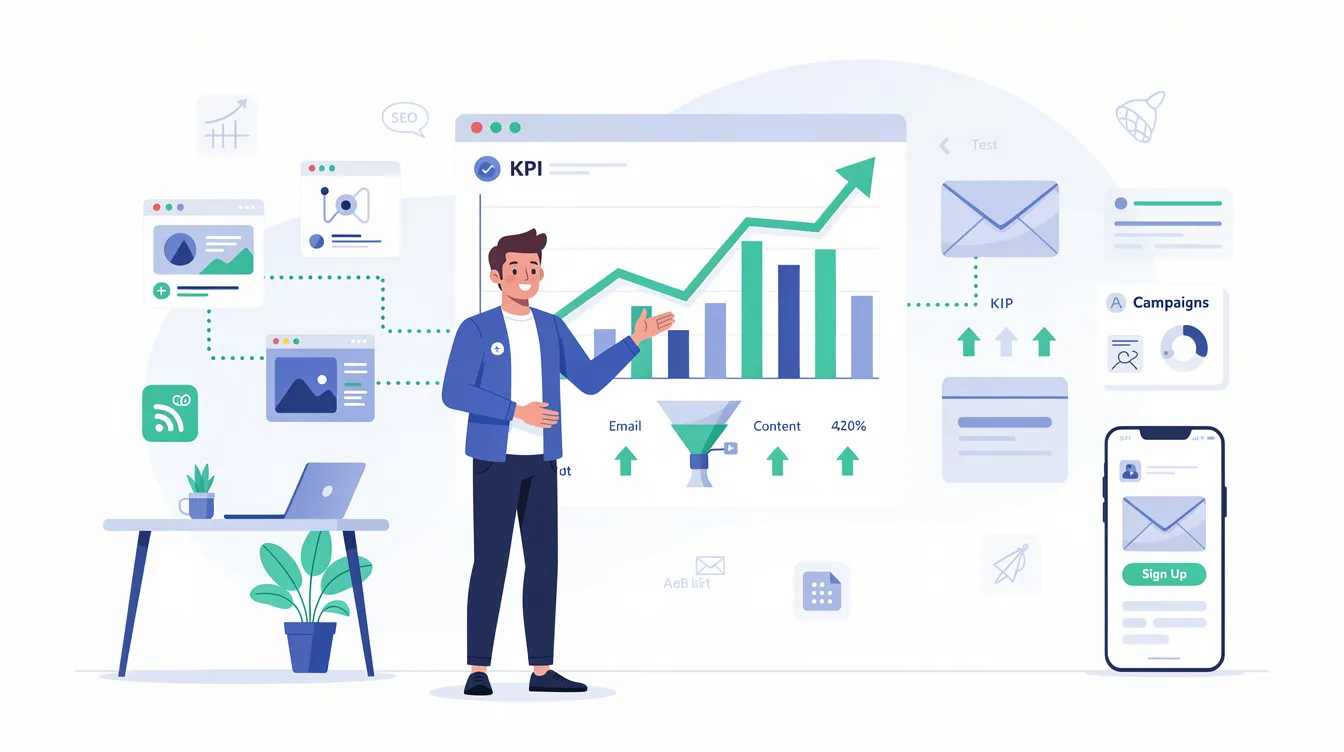
Growth Marketing focuses on data driven insights to make decisions on the best performing options and strategies that promote the long term growth of the business
-
Includes optimizing all aspects of the customer journey, not just acquisition
-
Main emphasis are on things like A/B testing, referral programs, customer loyalty, and maximizing customer lifetime value
-
Aims to reduce the most common pain points customers experience in the purchasing process and beyond
-
Things such as email marketing and building a strong brand authority work to provide a strong reputation that potential customers can trust and recognize
If you are operating as a small business owner you will be competing in a crowded market for attention from customers. You will often have a low budget, and not a lot of extra free time, which is what makes a growth marketing campaign such an important advantage for small businesses. The growth marketing approach is a data-driven, experimental methodology that is especially important for small businesses looking to maximize results with limited resources. Digital marketing is a core component of growth marketing strategies for small businesses, helping to increase revenue, customer base, and brand presence. Typically, these campaigns can help your business scale more efficiently without having to spend large amounts of money on what can sometimes be meaningless and wasteful advertisements.
Growth marketing is a type of strategy that focuses on the customer journey, as opposed to the initial acquisition of a customer. Throughout this guide, we’ll cover the best strategies for running a growth marketing campaign and how it can benefit your small business. Growth marketing is more of a trial and error system, to learn what customers are enjoying and how to keep them engaged with your business through all aspects of the purchasing process. Growth marketing aims to optimize the entire customer journey, not just acquisition, and is important for building long-term business growth by focusing on retention and loyalty as well as acquisition.
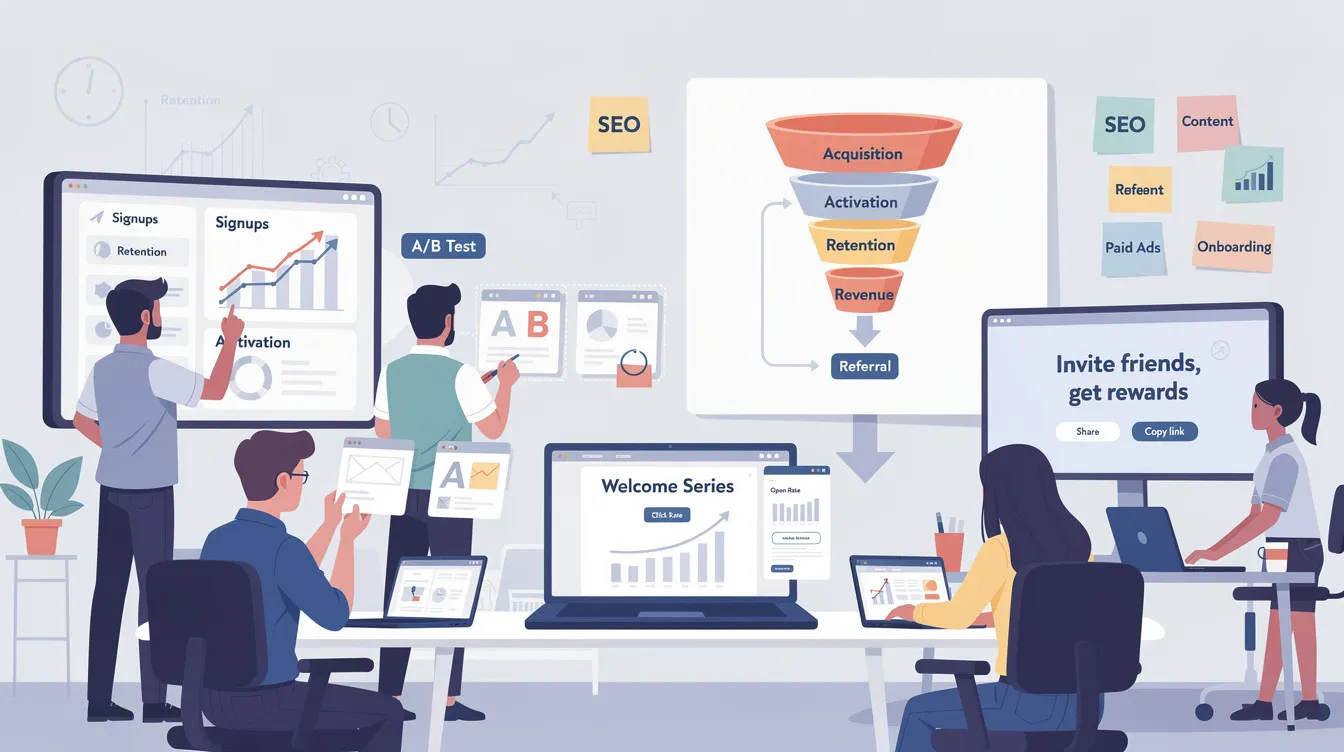
This guide will cover the different aspects that involve the tactics used in a growth marketing campaign, what aspects are used in these, success stories of other businesses using this tactic, and how it is able to benefit businesses that invest in growth marketing. A common model for optimizing the customer journey in growth marketing is the AARRR framework, which includes Acquisition, Activation, Retention, Referral, and Revenue.
Customer journey mapping is a key part of growth marketing, helping businesses understand every customer touchpoint from awareness to post-purchase support.
What is Growth Marketing?
Growth marketing focuses on a data-driven approach that aims to improve all aspects of the entire customer journey, rather than just getting customers to make a purchase from your business like traditional marketing focuses on. Mainly, after making a purchase, customers will go through a new process, which is the main focus of growth marketing. Growth marketing principles form the foundation of this approach, emphasizing data-driven experimentation, continuous testing, and holistic growth objectives.
By analyzing data collected through your sales funnel, you are able to improve different pain points your customers may have and tweak your processes to ensure an improved amount of customer loyalty. When considering growth marketing vs traditional marketing, it's important to note that growth marketing takes an iterative, experimental approach, while traditional marketing typically relies on static annual plans and remains unchanged regardless of performance.
Growth marketing emphasizes measurable results and ROI, whereas traditional marketing often lacks a strong emphasis on data-driven insights and analysis. Growth marketing takes a data-driven approach to optimizing the entire customer journey, focusing on continuous improvement and adaptability.
As you collect this data, look at different aspects of your sales process between you and your customers from acquisition, learning, retention, and referrals. Trying to perfect these steps will increase customer loyalty and ensure customers are satisfied with not just your product, but also how your business treats its customers and manages repeat customers. Growth marketing makes a significant impact by helping businesses retain customers, which is more cost-effective than acquiring new ones. Retention is a critical driver of long-term growth, as it is more cost-effective to retain existing customers than to acquire new ones. Growth marketing helps businesses achieve sustainable growth by focusing on retention and loyalty.
Growth marketers operate with agility and experimentation, continuously testing and optimizing strategies to maximize results across different channels and tactics. They turn data-driven insights into actionable experiments to improve marketing outcomes and achieve key performance indicators (KPIs). This type of marketing requires a multi-disciplinary approach, with marketers possessing a broad base of skills and deeper expertise in specific areas.

Main Characteristics of Growth Marketing
Growth marketing differs from a traditional marketing effort in a few ways. The most common practices of growth marketing include:
-
Data Driven Approach - Growth marketing heavily relies on data analysis to make decisions to find trends and certain pain points customers have to be able to improve customer’s experience and make more informed decisions about your business. Gathering data is essential for understanding user behavior, identifying trends, and optimizing marketing strategies through real-time insights. Setting up key performance indicators (KPIs) is also crucial to track the success of growth marketing efforts and ensure alignment with business objectives.
-
Experimentation of Strategies - Things such as A/B testing for messaging, website pages, and purchasing forms helps provide information on what works best and easily compares two different ideas to allow businesses to know the best performing practices. Growth marketers use data and measurement, including dashboards and A/B test analysis, to inform strategic initiatives that enhance customer engagement and drive long-term growth.
-
Optimizing The Entire Funnel - Growth marketing focuses on improving the entire customer journey, from beginning to end. Compared to traditional marketing efforts, which focus more on acquisition and spreading your business name. Marketing automation plays a vital role in delivering personalized experiences and managing customer relationships effectively throughout the funnel.
-
Agile and Quick Changing Solutions - Since growth marketing focuses on responding to the data you are collecting, you will need to be ready to quickly adapt to trends, changes, and possible solutions found through your data collection and things like A/B testing. Understanding user behavior enables quick adaptation and optimization of marketing tactics for better engagement and conversion rates.
For small businesses that are short on cash and need to optimally use their resources, growth marketing can help improve customer retention while ensuring the customers who make purchases through your company are satisfied and more likely to give you positive reviews, good word of mouth marketing, and allow you to spend money on things other than one off advertisements.
Growth Marketing Campaign vs. One Time Campaigns
For most small businesses, it can be easy to slip into one time marketing efforts that typically don’t produce the best long term results. For example, you may buy a sponsored ad when sales slow down or once a year campaigns that are difficult to track the impact of. Growth marketing initiatives, on the other hand, are integrated into your overall business plan and marketing plan to drive sustained revenue growth by continuously testing and optimizing strategies that align with your company’s objectives.
A sporadic marketing effort might be a low cost solution for small businesses that are short on cash, but a more effective strategy could be to enact a growth marketing campaign that focuses on increasing customer retention, customer satisfaction, and promotes the customer journey to be more simple and effective. Also, as you invest in a growth marketing campaign your business is able to track the data more accurately as compared to trying to judge these spikes that might come from a one off campaign and vague metrics.
Key metrics such as click through rates are especially important for evaluating the effectiveness of marketing campaigns and ad performance, helping you make data-driven decisions.
A growth marketing campaign focuses more on structured, targeted goals that are easily measurable for the business to see the impact of. Growth marketing helps businesses identify and target potential customers, focusing efforts on the right audience segments most likely to convert and become loyal customers.
Growth marketing strategies are also designed to adapt quickly to market changes, while traditional marketing strategies tend to be more rigid and less responsive. As these efforts are continued to be worked on, it not only gives your business a better and more satisfied base of customers, but also a better reputation in the industry by building a strong trust with customers who have tried your product or services and reviews by satisfied customers.
Importance of Customer Feedback in Growth Marketing
Collecting customer feedback and detailed data points on the customer journey is a vital aspect of growth marketing. A core principle of growth marketing is putting customers at the center of all marketing efforts to deliver personalized and relevant experiences. When using strategies such as A/B testing, it's crucial to be able to monitor the effectiveness of the two different pages or forms you are using to know which one is performing the best.
Customer engagement throughout the entire customer journey is essential for building loyalty and retention. To best understand these key metrics, businesses can do things such as a post-purchase survey, tracking data on their website pages, tracking what searches led users to their website, and what almost stopped customers from making a purchase with them.
The different pain points mentioned previously are all key factors to best understand how their campaign is performing and things they need to change to get the most out of their growth marketing efforts. Being able to get feedback from customers enables your small business to know what it needs to focus on, and narrow your efforts into what makes the most sense to better relate to your customer base. Additionally, tracking customer referrals is a key metric for measuring the success of growth marketing efforts, as referrals can create growth loops and drive repeatable business success.
There are a few common examples of different tools and software that are able to help small businesses track this type of data at a low cost. Below are some suggestions for the best tools for business owners to use to do this:
-
Google Analytics and Google Search Console - Tracking website data, statistics, and searches that lead users to your website. Optimizing for search engines (SEO) and local SEO can significantly improve your website's visibility in both general and local searches, helping you capture high-intent organic traffic.
-
Email Platform Stats - Most email marketing software will provide valuable insights such as open rates, click rates, and conversion rates. Social media analytics are also essential for tracking engagement and performance across your social media channels.
-
Customer Relationship Management Software - Allows you to track leads, calls, sales, and what step customers are at in the purchasing process. Referral programs and tracking customer referrals are important for driving new business and measuring the effectiveness of your growth marketing strategies.
Effective growth marketing strategies include content marketing, A/B testing, email marketing, and referral programs to drive customer engagement and retention. It's also important to monitor your churn rate, which is the percentage of customers who stop doing business with your company, as a key indicator of long-term growth and customer satisfaction.
Understanding Customer Lifetime Value
Customer Lifetime Value (CLV) is one of the most important things you need to understand when doing growth marketing, especially if you have a small business and want to get the most out of your marketing efforts. CLV is basically the total money you can expect to make from one customer throughout their whole time with your business, which is from when they first find you to their latest purchase and even beyond that.
If you're doing growth marketing, understanding CLV is something you really need to focus on for building a business growth strategy that works for getting new customers and keeping the ones you already have.
When you're calculating CLV you need to look at how your customers behave, like how much they buy and how often they make purchases, and how long they stick around with your business. Using customer data and getting feedback, your growth marketing team can figure out which customers are worth the most and make marketing campaigns that get existing customers to come back, buy more, or tell their friends about you. This way of using data helps small businesses focus their marketing strategy on the channels that actually work and give you the best return on what you spend.
For example, if your business formation service sees that customers who sign up for ongoing compliance tools are worth more money over time, you can create email marketing campaigns or loyalty programs to keep these relationships strong. On the other hand, if some customer groups have a lower CLV, you can change your marketing messages or how you onboard new customers to better help them, or you can focus more on getting new customers who have higher value potential.
CLV also connects closely to customer acquisition cost (CAC). When you compare CLV to CAC, you can figure out if your marketing efforts are actually worth it and if they can keep working long term. A good growth marketing strategy tries to make CLV higher while keeping CAC as low as you can, making sure that each new customer actually helps your business grow overall.
CLV also helps you optimize your marketing funnel by showing you where customers drop off and what keeps them loyal for the long run. Through A/B testing, conversion rate optimization, and looking at data regularly, you can improve your marketing tactics to make customers happier and increase their lifetime value. This could mean making the onboarding experience better for new users, giving them educational resources about business compliance, or offering special benefits to customers who have been with you for a while.
Understanding and using CLV gives small businesses the power to make better decisions about where to put your marketing budget, how to make the customer experience more personal, and how to grow your business in a way that lasts.
When you focus on the whole customer lifecycle growth marketing creates a foundation for success over time, higher revenue, and customers who stay loyal and help fuel more growth for your business.
Effective Growth Marketing Strategy Benefits
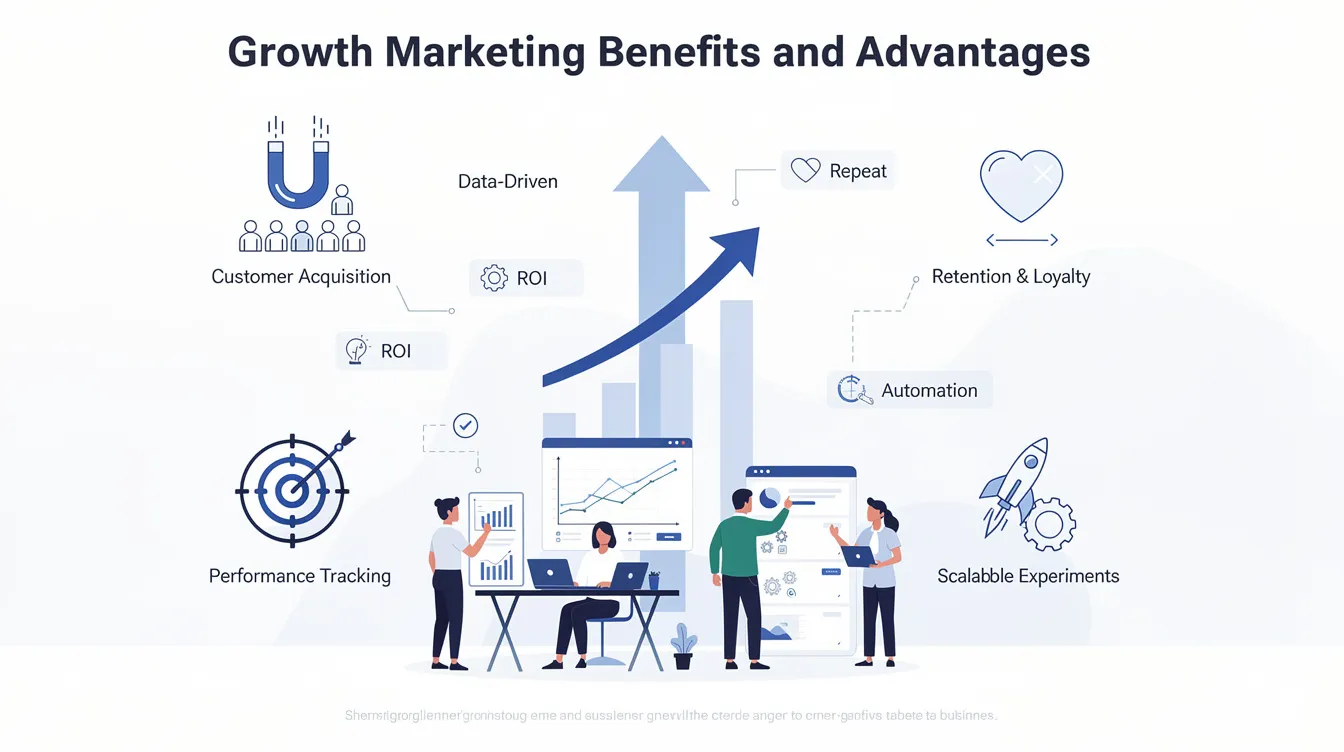
A strong growth marketing campaign is able to give your small business many benefits while keeping costs relatively low compared to a typical widespread marketing campaign. This is because a growth marketing strategy will focus on leveraging data to make informed decisions and changes to your business website and pages. These informed decisions will most likely need to be changed quickly as you will be doing multiple A/B testing to collect this data, but all the information collected will be from your own customer base and give you valuable insight into how your real customers navigate and feel about your business.
Growth marketing strategies drive growth by focusing on high-impact, data-driven initiatives that utilize experimentation and comprehensive tactics across the customer funnel to foster business expansion and customer engagement.
-
Better ROI - As opposed to a large upfront chuck of money being spent like a traditional marketing strategy, you will be continuously experiments and tests to discover what is the best course of action. As you find what works, you are able to double down and invest more into that aspect, while being able to quickly drop or change things and pages that do not work as well.
-
Gather More Accurate Data on Your Customers and Find How They Actually Think and Feel About Your Business - Since you will be collecting data straight from your customers such as the best wording for messaging, what target market is showing the highest conversion rates, and where users tend to fall off or leave your site and forms. After some time of collecting and analyzing this customer data, you will get a much better understanding of your customers and know that the firsthand data is accurately representing the results. This is more cost effective than a traditional marketing campaign as you will eliminate the guess work of mass marketing plans that can sometimes lead to costly mistakes that a small business short on cash can not afford to make.
-
Adapting Quickly by Making Data Driven Decisions - Growth marketing allows you to do this and make data driven decisions in the process. A simple A/B test of home pages for your website can easily show you which one is driving higher conversion rates and you are able to change the main page everyone will see into the best performer. You can also quickly adapt to new common found issues that your target customers are experiencing, and be the first to address these needs. Additional aspects of this such as a change in messaging, responding to trends in the industry, and seeing what competitors are succeeding with are all other things that are able to quickly be implemented into your own business at speeds that will most likely be faster than much larger companies that have more to integrate with.
-
Improvements to the Overall Customer Journey - Creating strong relationships with customers, showing them the value of using your product or service, and emphasizing these benefits are all great advantages of growth marketing. By optimizing for the entire customer journey, growth marketing builds a loyal customer base and creates a sustainable business model. Personalized customer journeys and lifecycle email marketing enhance engagement and retention by tailoring messages based on customer behavior and preferences. Making the experience for customers the best you can leads to higher satisfaction, more return customers, and a better reputation in your industry.
Common Examples of Growth Marketing In Practice
Some businesses have used a well thought out growth marketing strategy that focuses on the customer journey and emphasizing the satisfaction of customers. They were able to do this by offering a subscription model to keep users engaged, being able to offer competitive prices, and by putting an emphasis on making the customer journey more enjoyable.
As the following examples are shown, you will more than likely recognize these brand names as their success has boosted them into much more relevance through their efforts and accomplishments with their growth marketing strategies.
The first example is Harry's, the fast growing grooming brand. When this business started, they were facing challenges of competing with lifelong brands such as Gillette, Schick, and Bic. They had to find a way to break these barriers and "force" themselves into the market and into the minds of consumers. To do this, they begin by being one of the first businesses in this industry to offer a subscription package for customers. They offer differing timelines for when these packages arrive to your door varying from every two, three, or six months depending on your personal preference. This customization, combined with the ease of having the supplies delivered right to your door made Harry's stand out right away from their competitors and offered customers a much needed change in the shaving and razor industry.
This type of strategy that marketed toward customers and made the customer journey much easier, by delivering products that typically weren't offered for delivery, as well as having a subscription model allowed customers to create a lasting relationship with the brand which promoting more brand loyalty.
Another example of a successful growth marketing campaign is by Slack, the B2B brand that changes how business teams communicated. Slack was able to solve a glaring pain point among businesses, that most people didn't even know existed. For year, businesses used emails and paper memos to communicate across departments and teams, but Slack was able to give them a faster, more organized way to do this. As Slack grew through word of mouth, users inviting other users, and by popularity, they were able to become a staple of most businesses as they made communication between teams, departments, and even different businesses much easier and efficient.
This word of mouth marketing, as well as the users inviting others to the platform did not just happen because they were happy with the product. Slack was able to make what was a pain point for most businesses extremely simple and efficient as they were able to implement a new way to disperse information and delegate tasks. They were able to essentially create a new market for themselves by solving an extremely common pain point, and through their constant updates and improvements for ease of access to users they have continued to be the leading business in this new industry.
From these two examples you can see how having a focus on the customer journey, their experience with your product or service, and being able to address common pain points and issues can make a huge impact on the success of your business. These efforts were not a part of a highly expensive marketing campaign, they were data driven decisions that made users experience better, and created a lasting relationship with users as they started to rely on these platforms for much needed things like shaving supplies and communication between teams and departments in their business.