Guide to Managing Essential Business Formation Documents
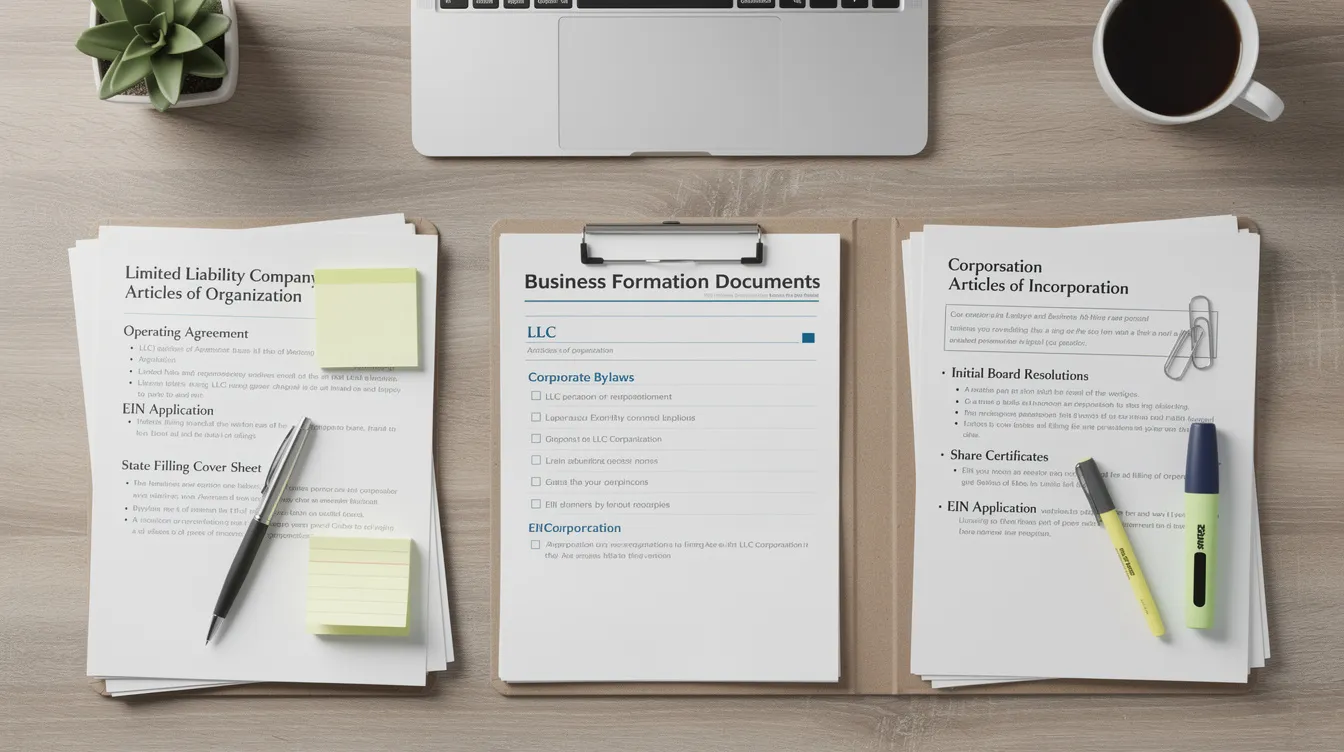
What Are Business Formation Documents
Before officially forming your business entity, or shortly after, it’s important to understand the necessary documents that will be required for your business to file and maintain to ensure your continued compliance with any state and federal regulations. For starters, once you form your business you will be issued articles of organization (LLC) or incorporation articles (Corp). These foundational legal documents include basic information such as your company’s official name, address, purpose, and duration. Incorporation articles are required to establish different types of business entities, and while articles of incorporation and articles of organization serve similar purposes, they differ based on whether you are forming a corporation or an LLC.
Most companies are legally required to file articles with the state's secretary to establish their business entity. We will go into more detail in this guide on these documents, but keep in mind how important they are and to keep them somewhere safe, as you will regularly need to provide these to vendors and partners. Registering your business makes it a distinct legal entity. After you have your foundational documents, most small businesses can register by simply submitting a registration form for their business name with state and local governments.
You will also be dealing with operating agreements, EINs, bylaws, and registered agent details and similar documents relating to your business. All these documents for your business are important and you should plan to have a way of storing them to ensure you do not lose them or allow them to be damaged in any way. This guide will go into detail on what these different documents are, why they are important, and what they mean for your business entity.
Articles of Organization
One of the most essential business formation documents for an LLC is the articles of organization. This document will be issued by the state you formed your business in and highlight the business name, purpose, address, registered agent, and structure of the business. The articles of organization also specify the ownership structure and internal management framework of the LLC, outlining how ownership interests are distributed and how the business will be managed. This document will be the main thing that enforces your business’s legal status to state and federal agencies. Keeping your articles of organization in a safe, easy to access place will help you when vendors, banks, and partners require to see it for proof of your business formation.
Forming an LLC is a popular choice for business owners due to its flexibility and liability protection.
Without obtaining the articles of organization for your business it will not be considered a legal entity, and the business owner will not be provided the liability protection that is granted to LLC owners. Once you submit to form your business with the state you will be doing business in, you will either be sent this right away or will have to wait for the approval process depending on the state to get access to it.
It’s extremely important to not begin business operations until obtaining this document. In the case of a rejection for any reason, your formation will be delayed and this can cause problems if you have already started doing business without a legal business entity. Common things such as a conflicting business name or incomplete information on the form can lead to the state rejecting your application. If your state is an instant approval state, you are typically able to fix this right away, but if the form will need to go through an approval process you might not know the reason for this rejection for up to a few weeks.
Think of this document as your business birth certificate. You will need to provide it for a multitude of different reasons which is why keeping it in a safe, secure, and easily accessible place makes your life much easier. Typically states will issue you an online certified document that you can electronically store and also print off when needed.
Articles of Incorporation
The incorporation process is the initial step in legally establishing a corporation, which involves filing articles of incorporation with the state's secretary.
Corporations and nonprofit organizations will be issued articles of incorporation as opposed to LLCs articles of organization. This document will essentially follow the same guidelines as before, stating the business purpose, name, shareholders, registered agent information, stock structure, duration (typically perpetual), and also the names and addresses of the initial board of directors. These are specific to corporations and nonprofit organizations so it’s important to understand what your business structure is going to be before submitting to form your business.
Articles of Incorporation establish a corporation's existence and include the corporation's name, purpose, and initial board of directors' names.
As mentioned before, your business will not be considered a legal entity until receiving this document. So, do not start conducting business until this has been approved by your state and you receive a confirmation letter including the articles of incorporation.
Both the articles of organization and articles of incorporation will be public information, so whatever address and ownership information you put on these documents will be viewable by anyone who looks up your business. Nonetheless, these documents are the most important documents you will be issued for your business and need careful handling.

Operating Agreement
An LLC operating agreement is a key business formation document that outlines the rules, member responsibilities, and decision-making processes within an LLC. This document also specifies the ownership structure, including ownership roles, interests, responsibilities, financial procedures, and voting structure for important decisions. Additionally, the LLC operating agreement details profit distribution among members and establishes procedures for raising additional capital to support the company's financial needs.
Even a single member LLC should have an operating agreement, but it is especially important for LLCs with multiple owners to solidify their ownership percentages and roles within the business before any potential disagreements arise. Owners may have differing percentages of authority, and this document will outline each amount and solidify, in writing, what these are and keep them from being changed without approval.
While an operating agreement is not always legally required by state law, it is highly recommended for legal compliance and protection. The agreement helps enforce the liability protection provided to LLC owners and details the main business operations and procedures, making it much more difficult to pierce the corporate veil.
The operating agreement will also explain the procedures for changing things regarding the business, such as ownership changes, buying out members, dissolving or ending the business, voting on major changes, and procedures for raising additional capital or adding and removing members. Without this, it can be difficult to move things along if there is a disagreement among members and with no rules in place in the case of a tie on votes or members leaving the business.
Keep in mind, the choice of business structure can impact personal liability, tax benefits, and legal recognition of the business.
Corporate Bylaws
Similar to how an operating agreement outlines the operations and processes in an LLC, bylaws accomplish this for corporations and nonprofit organizations. These bylaws will define the guidelines for voting, meetings, and roles of the directors. Bylaws also outline procedures for board meetings, including how they are conducted and voting processes, providing a clear legal and procedural framework for corporate governance. Some states require these, but even if your state does not they can be extremely helpful to establish corporate norms and standardized processes.
Bylaws are a bit more difficult to change compared to articles of organization, as these amendments will need to be voted on the changes as needed. Typically, corporations will need to be changed less than LLCs so this typically is not an issue. Bylaws will also include the rules and regulations for issuing, classifying, and transferring shares and stock.
Shareholder agreements are another important legal document that outlines the rights, responsibilities, and ownership details of shareholders, complementing the corporate bylaws and helping to manage shareholder rights and share transfers.
Registered Agent
Differing from the other business documents in this article, your registered agent will not be a separate document you receive. This information will be on your articles of organization or articles of incorporation when you form the business. However, it is just as important as the other documents. Your registered agent will be in charge of receiving service of process and important documents sent to your business by the state you are registered in. Essentially, this person will be how the state and courts are able to contact your business. Every business will be required to appoint a registered agent when forming and will need to continuously update their information in case of any changes such as moving addresses or changing agents.
Failure to maintain a registered agent can lead to your business being dissolved or taken out of good standing by the state, which means you will not be able to lawfully conduct business at that point without correcting these issues. This can be costly, which is why you will need to be aware of who your registered agent is and be able to get in contact with them when needed.
There are certain guidelines and requirements that determine who is able to serve as registered agent of your business, mainly that they are 18 or older and have a physical address in the state the business is registered in. For a more in depth overview of registered agents see our guide here, or if you plan to serve as your own registered agent see our guide explaining this process here.

Employer Identification Number (EIN)
An employer identification number, or EIN, is the nine digit number that is issued to each specific business. Think of it as your business social security number, as no business will have the same number. This will be used for many things such as your taxes, hiring employees, opening a business bank account, protecting your privacy by not using your own personal social security number, and some states will require you to submit this number for your annual reports.
The EIN will be issued through the Internal Revenue Service (IRS), so the process is more strict than other documents. Ensuring you have all information correct and matching to what is on your business information and articles of organization is important to avoid rejections and to ensure the EIN is issued to the correct business. Each business can only obtain one EIN for its lifetime, so once you get your EIN you will not be required to renew it, ever. At Firstep, we offer services to obtain an EIN for you while forming your business, as well as obtaining it if you either lost the documentation or have formed your business and not gotten an EIN yet. To see a more detailed guide on what EINs are and how they work, see our guide on them here.
Obtaining Business Licenses
Getting the right business licenses is a fundamental step when you are forming your business and you need to make sure your business is legally authorized to operate. The licenses that you will need depend on what type of business structure you are forming, whether you're starting an LLC, corporation, partnership, or another type of business entity. Each business structure may have different licensing requirements and these depend on what kind of business activities you plan to do and how your business management structure is set up.
When you start the process, you'll need to provide basic information about your business, such as what your company name is, your business address, and your employer identification number (EIN). You may also need to submit supporting documents for your business formation like your articles of incorporation if you have a corporation or articles of organization if you have an LLC. These documents help federal agencies, state governments, and local authorities to verify that your business has legal status and that you meet all the regulatory requirements that are needed for your business.
Business licenses get issued at different levels of government depending on your business. You may need to get licenses from federal agencies, your state's office, or local city and county authorities depending on what industry you are in and where your business is located. For example, if your business operates in food service you may require a health department permit, and if you have a retail store you will likely need a sales tax permit for your business. There are also some professions that require specialized professional licenses so that you can conduct business legally and operate your business properly.
Annual Reports
When managing a business, whether that be an LLC, Corporation, or Nonprofit, almost all these businesses in all states will need to file an annual report with their Secretary of State each year. Depending on the state your business entity is registered in the report due date will vary, as well as the structure of your business. These reports will include information regarding your business such as the physical address of your business, registered agent information, and ownership information. If there are any changes to this information, you will need to submit this new information on your annual reports to ensure your business stays in good standing with the state and avoids any potential fees or fines imposed on your business.
If your business does fail to file your reports on time, you can face administration dissolution which can lead to costly fines on your business. However, submitting reinstatements can restore your business's good standing by catching the business up and previously missed annual reports, and paying a reinstatement fee that will vary depending on the state your business is registered in. Keeping a list of important renewal dates each year on your business calendar can help ensure you do not forget these deadlines, as well as hiring a professional filing service that submits these on your behalf.
Professional filing services, such as us here at Firstep, are able to track these due dates in our system and ensure your business does not miss another annual report again. Also, we are able to offer multiple different services related to business compliance and regulations that can help to give business owners more time to focus on their operations day to day. For more information on everything we offer to new and existing business owners, see our page here explaining it all!
Putting It All Together
Business formation documents are the essential papers that set up your business structure, designate the management of the business, assign ownership percentages and roles, and much more. These documents are critical for businesses to ensure they are maintaining compliance to all state and federal guidelines and regulations surrounding their business. To legally conduct business, as well as performing typical business operations that will be required throughout the business lifetime business owners will need to keep these handy to prove the legal existence of the business.
The documents you receive when forming your business will need to be kept in a place that is easy to access and where you will not lose them. The majority of the time, states will issue you the certified copies of your formation and other documents online, so you can store them electronically. A folder on your computer that contains all these is a great way to keep track of them, but ensure you have backups just in case.
Now that you are aware of the importance of these documents and how you will be asked to use them for your business operations, you can feel more prepared to efficiently manage your business. If you need help forming your business or managing your compliance requirements, let Firstep get your started today!