A Guide to Business Registration Made Simple for Beginners
Starting a new business is about having a well thought out plan, and then being able to execute this plan effectively. Registering your new business is able to give it a good legal standing, protect your personal assets, and many other advantages from dedicated business bank accounts to financing solutions. This guide on business registration will give new business owners a clear path to follow when registering a new business that you will be able to follow confidently.
Introduction to Business Registration
Registering your business is an essential first step in shaping your idea into a legally operating business. This step involves key details such as your business name, structure, physical address, and notifying the appropriate agencies such as the Secretary of State.
This process is able to give your business a legal operating identity, and also gives you the personal liability protection that is so important to most LLC owners. The protection ensures your personal assets and business assets are considered separate in case any lawsuits or debts are incurred by the business. Typically, most businesses will need to register with the IRS to obtain an employer identification number (EIN) which will be used for tax purposes, hiring employees, etc.
Whether you are choosing to operate as an LLC, a corporation, or another entity, registering the business is an important first step to take to operate legally and confidently from day one.

Begin with the Name: Availability, Brand, and Protection
A good place to start the process is choosing a business name that is available. You will generally have to search your state's business database to ensure there are no currently active businesses with this name, or a confusingly similar one. Even if you don't plan to register your name right away, it can help to have an idea of what is available especially if you are having trouble thinking of a name. It's best to not conduct any official business activities before finalizing your name and it is registered with the state, as this can help avoid any costly rebranding later down the road.
Your business name should be a unique, memorable name that relates to your purpose or business operations overall. It's a good idea to keep in mind social media handles and give those a look too during this process as well as website URL availability.
Choose the Right Structure: Liability, Taxes, Growth
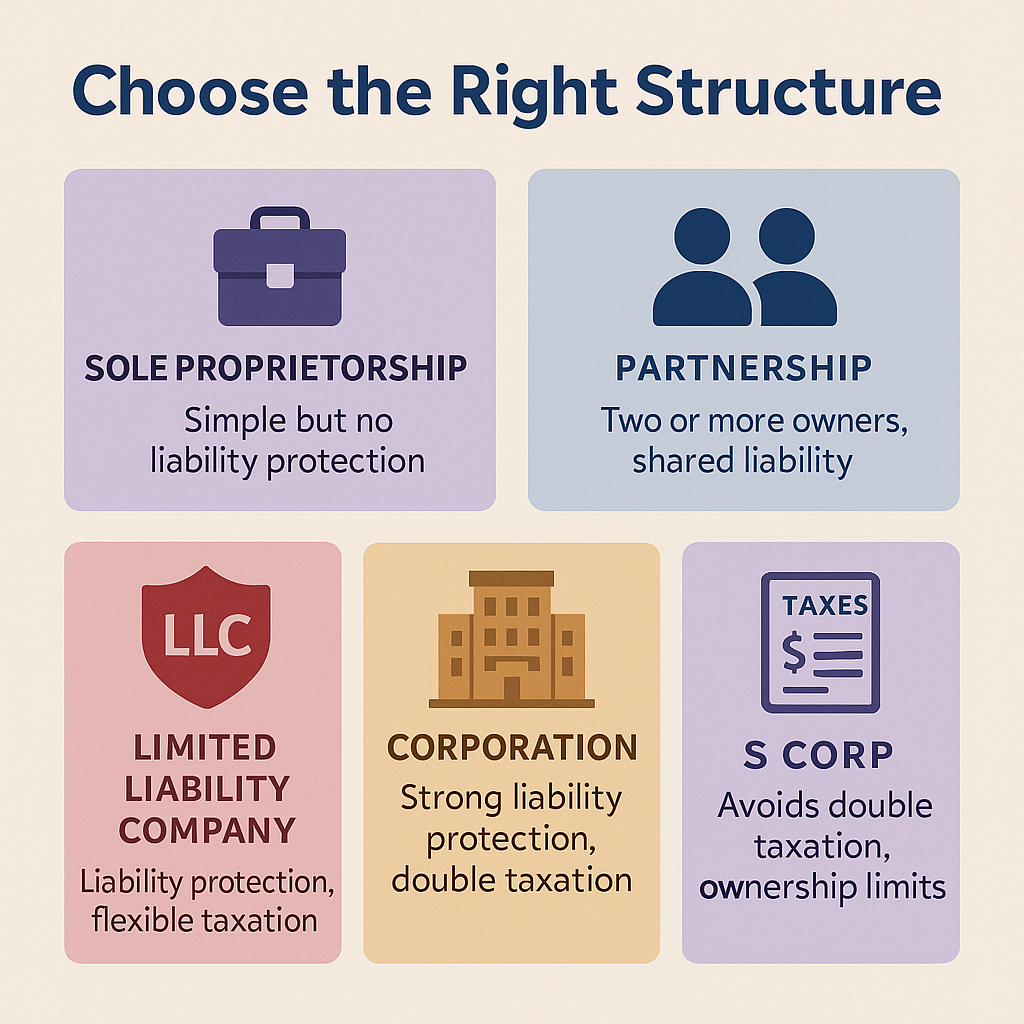
Your business structure determines how you’ll be taxed, how decisions are made, and how well your personal assets are protected. Making the correct choice in the beginning helps to avoid restructuring your business later down the line which can be a costly event.
-
Sole Proprietorship. The simplest path for a single owner but offers no personal liability protection. If your business is sued or incurs debt, your personal assets are at risk.
-
Partnership (General or Limited). Two or more owners share profits and obligations. General partners carry personal liability; limited partners can limit exposure when properly structured, but are not fully protected from liability.
-
Limited Liability Partnership (LLP). Common for professional groups (law or accounting firms), an LLP can provide limited liability while preserving partnership tax treatment.
-
Limited Liability Company (LLC). The default for many small businesses. LLCs combine personal liability protection with pass-through tax treatment and flexible management. You can also elect corporate tax status later if it suits your growth or investor needs.
-
Corporation (C Corp). A separate legal entity designed for scale. Clear governance, the ability to issue multiple classes of stock, and a structure investors know. The trade-off is more formality and potential double taxation (corporate tax on profits, shareholder tax on dividends).
When deciding, weigh four factors: liability shield, tax outcomes, governance complexity, and capital plans. If you’re unsure, an LLC is often a good starting point as this is a structure that has a lot of flexibility and typically can be easily changed as your business grows and evolves.
The Formation Package: What Gets Filed and Where
Business formation is the process of actually bringing your entity into existence, and it involves the formation of the business with several key steps. You’ll register with your Secretary of State and file the right charter documents in the business register, which is the official place to register your company:
-
LLC: Articles/Certificate of Organization or Formation
-
Corporation: Articles of Incorporation
-
LLP/Partnership: Partnership agreement plus any required state registration
While forming your business, you will typically need to provide the business name you chose, the principal and/or mailing address your business will use, a registered agent and address they can be reached at, and details about owners, managers, or directors.. Certain states will also ask about the business purpose or NAICS code to list on your business page so people know the purpose of your business.
Using a business filing service can take care of all these registration steps for you and ensure your business gets approved and maintains compliance. This can be especially helpful if you are short on time or are too busy focusing on getting your business started up. You can also use a service for both the formation and renewal process, and most services, including ours, will bundle these into a package so you do not need to deal with submitting any filings and can focus on your business. The choice is yours, as the Secretary of State does not care who is submitting these documents for your business.
Once your formation is approved and officially formed, you will receive a certificate or stamped copy of your filing for your business records. It's important to keep these with your important records as banks and other vendors will most likely ask for them when setting up accounts for your business. Receiving this certificate means you have completed the registration process and your business set up is complete.
The LLC in Practice: Why It’s So Popular
Having an LLC provides the personal liability shield that most business owners want, and an LLC is able to offer these without the formalities and regulations corporations require. Your LLC can be member managed, or manager managed. Regardless of which one you choose, a good next step is to draft an operating agreement. Some states will require this document, but even if your state does not it can be an important and helpful document to have as it will set ownership percentages, voting rights, profit allocations, and procedure if a member leaves or is no longer a part of the organization.
If you decide to use a filing service such as Firstep Business Solutions, we offer custom templates for documents like the operating agreement that are available with the services we have. They will be tailored to match your business structure, information, ownership percentages, and more. Drafting these documents can be very time consuming and a certain language is required to ensure you are protected. We are able to take this issue off your hands and typically for a lower price than what a lawyer would charge to draft the same document for your business.
For more detailed information on limited liability company formation and annual maintenance, check out our guide on LLCs that covers a more in depth overview of them.
The C Corporation: Engineered for Capital and Scale
If you are planning to raise capital, issue equity, or go public, a C corporation is generally the route you will want to go. These will have more structure and include a board of directors, officer roles, and formal bylaws that determine the operations of your business. You will be able to issue stock, hold board member and shareholder meetings, and appoint officers to their roles.
Double taxation is something to keep in mind, but many companies are able to accept this trade off for a more investor friendly structure. Most times, the familiarity and ability to scale long term is worth dealing with the double taxation.
Federal Identity: Your EIN
An employer identification number (EIN) is essentially your business's federal ID or social security number. You will use this for taxes, payroll, opening bank accounts, hiring employees, and more. An EIN is a unique identifier for your business and will be issued by the IRS. Apply for one online, or a filing service like us are able to include this in the formation process so your business is set up for operations from day 1.
Banking and Financial Infrastructure
Opening a business bank account after receiving your EIN can help keep your personal and business finances separate. This is of huge importance to preserving your liability shield and keeping your books clean and organized. Banks will typically ask for your formation documents, EIN, and operating agreement (for LLCs) or bylaws (corporations) so you will need to have officially formed your business by this point.
Now, a good plan is to set up your accounting system, set up a payment processor, and connect business tools. Keeping organized records and documenting everything of importance makes tax season much easier for you, and once again is able to help with bookkeeping and making sure your business and personal finances are separate.
Limited Liability: What It Protects and What It Doesn’t
An LLC or corporation creates a legal shield between your business obligations and your personal assets. That shield is strong but not absolute. Three rules preserve it:
-
Keep separate bank accounts and credit cards. Reimburse owner expenses properly, don’t blur lines. Always keep your personal and business finances separate.
-
Adopt and follow your Operating Agreement or bylaws, document major decisions, and file required reports.
-
A loan or lease you personally guarantee bypasses the shield by design.
Even with perfect hygiene, certain exposures are still possible such as payroll tax issues, fraud, or misconduct. Insurance is your second line of defense.
The Compliance Calendar: Stay in Good Standing
Good standing is not a one-time achievement, it’s more of a maintenance plan. Expect to regularly deal with the following:
-
Annual or biennial reports to your Secretary of State.
-
Annual franchise taxes or fees where applicable.
-
License renewals at the state and local levels.
-
Registered agent service to remain current for service of process.
-
Update your business information if there are any changes to this to keep your business in good standing and avoid administrative dissolution.
Create a compliance calendar with automated reminders and assign ownership either internally or via a registered agent or formation service. Lapses lead to penalties, administrative dissolution, and operational headaches.
Our business offers a renewal service that includes these deadlines to ensure you never miss a report. This allows you to be able to focus fully on your business and not renewal deadlines, filing paperwork, and updating changes. We take care of this on a yearly basis and file early to avoid any late fees or penalties incurred by the state's office.
Special Case: Nonprofits
Nonprofits follow a distinct path. Starting as a nonprofit organization with state incorporation as a nonprofit corporation, drafting bylaws consistent with charitable purposes, and applying for federal tax-exempt status. For more information about nonprofit organizations, see our in depth guide on them here.

Business Owner Responsibilities
Once you’ve filed your business, being a business owner is so much more than just the initial paperwork. Besides daily operations and finances, you need to stay current on annual reports with the Secretary of State to keep your business in good standing. Other administrative tasks like paying taxes on time, keeping your business address updated and making sure all legal and state compliance is done in a timely manner are just as important.
Being compliant means getting and renewing any necessary licenses or permits and making sure your business follows all the rules and laws. Accurate record keeping is key. If your business address or ownership changes you need to notify the state in a reasonable time.
By staying on top of these tasks you’ll protect your business’s legal status and reputation.
Business Registration Timeline
The time frame to register your business will depend on your business structure and where you’re located. In most cases it can be done online or by mail and takes a few days to several weeks.
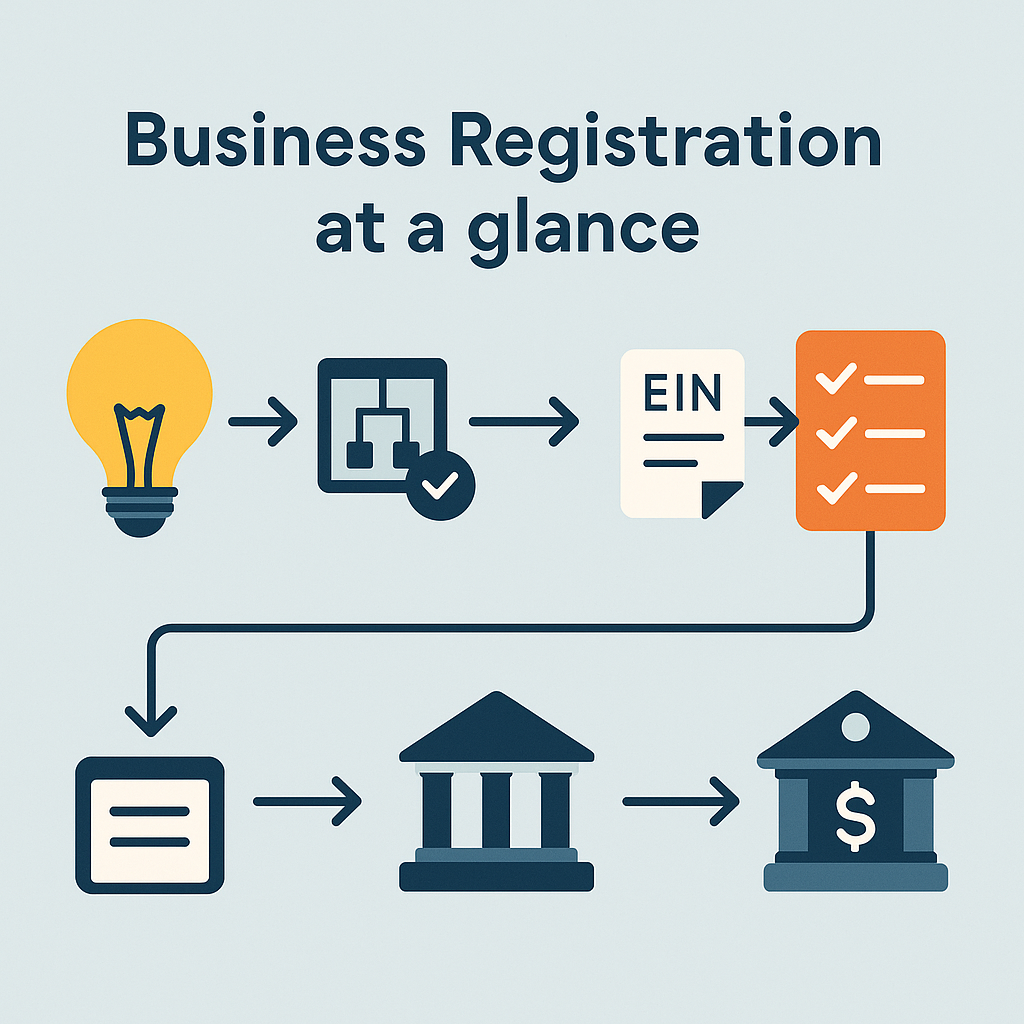
Start by choosing a business name and see if it’s available. Next choose the best business structure for you, whether that’s an LLC, corporation or another entity. Once you’ve made those decisions you can register your business with the state and apply for any required licenses or permits.
After registration you’ll need to maintain good standing by filing annual reports and paying taxes as required. Remember registration requirements, fees and processing times will vary by state and business type so make sure to research what applies to your business before you start.
Comprehensive Formation Packages
A quality formation package can streamline filing, provide a registered agent, include basic compliance reminders, and more. Higher-tier packages may layer on EIN acquisition and operating agreement/bylaw templates, a website builder, and banking resolutions.
If you value filing speed and accuracy, using a formation package can bundle multiple things into one which is cost effective compared to purchasing these services separately. The bundles we offer are able to ensure your business has everything you need to be able to operate now, and continue to operate legally in the future all in one place.
Why Use a Company Registration Service
You can file on your own, as many founders do. But a registration service earns its keep by reducing friction and errors. We know state portals, forms, fees, and edge cases. A knowledgeable customer service team is crucial for supporting clients throughout the registration process, providing guidance and ensuring all client needs are met efficiently.
From acting as your registered agent to keep your personal address of public records, to filing all annual reports that are due for your company, to reminding you of any filing deadline that is coming up, our services will ensure your business has everything it needs to stay in good standing and continue to operate legally. If you're juggling multiple things while in the formation process, then the saved time alone might be worth the fee for the services.
Transparency and quality service will ensure your business is set up properly from the start, which can eliminate the risk for any potential mistakes and fees down the line.
Cost Control Without Corner-Cutting
“Affordable” should mean efficient, not flimsy. File in a single state at first unless you truly need a multi-state footprint. Focusing on the essentials and avoiding unnecessary extras helps ensure an easy process for your business registration. Start with essential software, and adopt processes early so you don’t clean up expensive messes later.
Keeping the business structure as simple as possible until it is necessary to expand can help especially when you are a new business. Give yourself time to learn the ins and outs and understand all the requirements that come along with owning a business, and once you outgrow or have enough need to expand, then expand into more states and grow as an established business.
Keeping the Business in Good Standing Year After Year
The companies that last long term treat compliance as a necessary aspect of operating their business. Here’s a sustainable timeline:
-
Quarterly: close the books on time, review cash, pipeline, and hiring plans, pay estimated taxes, reconcile sales/use tax filings.
-
Semiannual: governance check-in, board/owner meetings, review of major contracts, insurance coverages, and privacy/security practices.
-
Annual: file state reports, renew business licenses and domain/SSL, adjust authorizations and signatories at your bank, refresh your cap table and ownership records, and update beneficial ownership filings and business information if anything changed.
Maintaining these routines keeps your business moving in the right direction year after year.
Document everything once, store it centrally, and make it easy to hand to banks, auditors, or investors. When trying to close a deal or obtain a loan, having everything in one place can make the process seamless and much easier.
Bringing It All Together
Business registration is not just paperwork. A thoughtful name, the right structure, clean filings, and a disciplined compliance routine create the foundation for every strategic move you make. Keep the process simple and affordable by focusing on essentials, using bundles and partner offers wisely, and calling in the right experts at the right moments.
A professional business filing service like Firstep can help bundle all of these requirements into one plan and ensure all compliance is done on time and correctly the first time.
Execute the steps in order and build habits that keep you in good standing. Do that, and you’ll have more than a registered business, you’ll have a sustainable platform for growth.